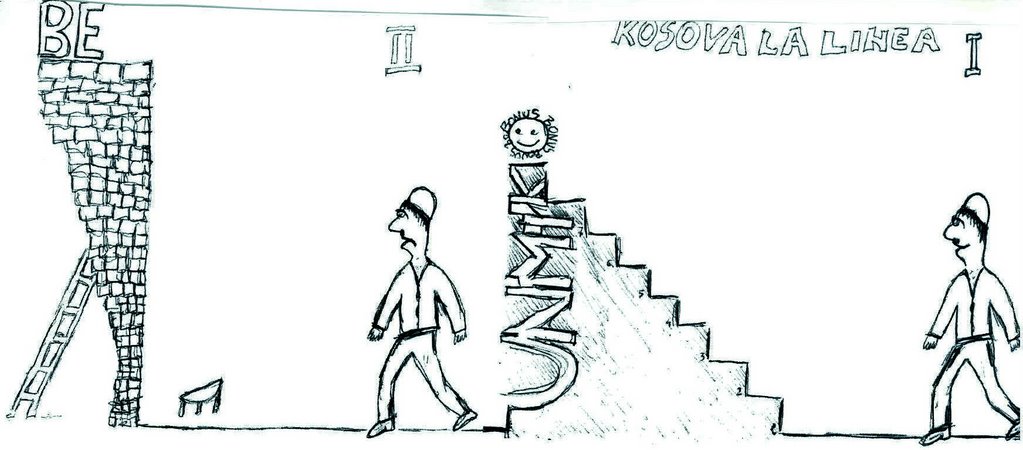
Monday, April 7, 2008

Dervishes of Kosova


By Kreshnik Bajraktari

The climax of mystical a ritual, which featured men attired in capes and gowns swirling about the room, occurred when each of the men approached Sheh Ruzhdi and he pierced their cheeks with a 
glinting skewer. Initially, Sheh the spiritual leader walks in taking his place in front of a semispherical cupola-wall, and only after that ceremonies start. He wears different robes, a woolen gown and a white hat. That is unlike the other ones and much higher. It also looks more theological. The followers are dressed in red silky robes wearing a white tunic over that, forming a kind of uniform. 
On top of their heads is a kind of plis (Albanian hat) looking woolen-hat though rounder makes it like a more traditional Muslim headgear. These hats are stored on a shelf that rings part of the room. The sons who stand in front to his left, occasionally guide traffic or oversee what is necessary to take care of during the performance. Valdrin, younger son, reads Kura’an verses from unfolding a scroll. The reading which is in Albanian lasts about ten minutes. Then, Dervishes continue moving their bodies to the right – left, that is really pronounced and also somewhat behind forming a kind of triangular movement.


As the evening wears on, it is clear that they are moving into a trance state. The movement, the drumming, the cymbals, the singing, the guttural breathing when the singing stops release a kind of spiritual energy excellently projected to the function of Dervishes performing in this octagonal room. Dervishes are punctured in the inner part of mouth with skewers penetrating all the way through the other side. This ritual of piercing with long sword shape skewers takes place after about an hour long and intensive dancing trances followed by singing and callings. “Allah, Allah, All-ah… Hou, Hou, Hou,…” refrain goes for as long as it roars as a guttural, circumferential sound only.

A ceremony held on January 20 in the western town of Gjakova, Kosova, provided a vivid illustration of the growing importance of the ancient Muslim fraternities of Dervishes.

Afterwards, as dancing goes on, at another moment a small group of Dervishes form a small circle and then a larger circle is made around them, still another circle, and finally another circle. This last one in particular is made of audience members as virtually all join in.

“In Islam you have obligations, for instance, to name God. He has 99 attributes so it is important to name God. God himself said that he could not be confined to air or earth, but he could be confined to a person’s heart. So, if we are sitting, standing, or lying down, it is important to name God,” explains Sheh Ruzhdi the purpose of this rituals.
Sheh Ruzhdi refers to legendary figure of Sari Satluk, first known Dervish missionary in Balkans, as he talks on human efforts towards reaching perfection.

The ritual is always performed by the Sheh, who inserts swords to his Dervishes with delicate touch and silent prayers followed by voicing calls that roar loudly from participants. When the Sheh first takes it up, he twirls it around between his palms silently saying some prayer. At some point he calls out by name some of the Dervishes to approach. They stand in front of him and open their mouths. He takes the device and quickly pokes it through the cheek. “I know who of the Dervishes is ready to pierce. They communicate to me without saying any word,” explains Sheh, his selection of candidates, as not all the followers get pierced, but only ones that are ready. The same kinds of devices are also used later when the Dervishes are pierced in stomach. Precisely with this group of Dervishes were also pierced Sheh’s two sons after all their engagement with accommodating guests, religious singing, playing and dancing.

The men did not flinch either, and continued to dance. Holding skewers with one hand, Dervishes continue their dancing and the procession with determination. Anyway, pierced Dervishes do not bleed at all, not during the dancing or even after the swords are taken out by the Sheh. And one cannot see any blood or wound on them. It is the complete trust in God that makes it an easy obligation, they say.

The rationale of performance represents the miracle of overcoming physical pain and therefore pitching consciousness into some beyond the body plan. These practices are supposed to improve and elevate followers. “All the believers must do good deeds and our education consists only of good deeds,” says Sheh. “We do not wish to hurt the hearts of people. It is God himself who directs towards the supreme good. He is the only source of determination. Therefore, we ask for Dervishes to set an example,” he says.

Sheh has a very active role and tremendous physical and mental engagement during the ceremonies. He could be compared to an opera director, as he actively leads and directs all elements. He moves in a circle with his right hand up directed in front of him and sometimes when rhythm increases his movement is so fast that is difficult to follow.
Despite the fact that ceremony was in celebration of the Shiite festival of Ashoora, the order does not belong to this branch of Islam, according to him. That is confirmed by yet another independent source unrelated to Dervish orders, but nevertheless familiar with theological developments. Sabri Bajgora, from Islamic Community of Kosova, says Dervishes are not Shiite.

Once persecuted and marginalized by the Serbian regime, Dervish orders are enjoying resurgence throughout Kosova. Their numbers are increasing, once secret ceremonies and rituals are being conducted with greater public visibility, and new temples, or tekkes, such as a modest new building in a suburb of Prishtina, the Kosovo capital, are opening regularly. They seem to quickly embrace a compensation of the historical flounder.

The family Musliu that runs this tekke used to be affiliated with a Dervish order for four generations now. But the new tekke opening in Prishtina represents a new stage of their development. Rizahi Musliu, who worked as a teacher for nearly four decades was nominated for Sheh in 1995 by Sheh Ruzhdi of Gjakova. Dervish Blerimi is his deputy when Sheh Rizahi is away, and is elected for taking the position after him. The first one from the family was Sheh’s grandfather, who got affiliated with the order. “We’re working hard to reach out to the people and we’re interested to expand.” They started processions with 5 – 6 people in 1995, and today the number of followers reached over 250. “The tekke is small to cope with people during important nights, since not only followers (myhybs) attend,” says Blerim. They also claim to have good relations with Islamic Community of Kosova. “We meet and receive regular visits of imams and discuss issues of common interest.”

Despite the hoisting of the order, in the very same town, not far from its center remains a neglected building of tekke and turbe – tomb temple, a sign of difficult times Dervish orders experienced under the former regime. It belongs to Kadiri order, which for the moment has no Sheh. Although, in a crossroad junction even today, its presence is quite obscure and looks weary because of long periods of disregard. While other structures and housing were immensely constructed in the neighborhood near “Sami Frasheri” High school, this turbe seems just as an old dwarfed building waiting to collapse.

Persecutions of Dervish orders

Dervish orders were founded and exist for several hundred years in Kosova. They originate from the time of ascetic Dervish missionaries (like famous Sari Satlluk) that arrived in Balkans from the East, and are credited for being a first contact and the force of spreading Islamic religion. Nevertheless, these orders in time acquired and incorporated beliefs of the native population, thus becoming more acceptable and eventually popular. Historically, the circumstances precluded Dervish orders development into a nation-wide religious category, not only because of the stereotyping, but also through forceful oppression they experienced under all foreign rules. Initially, it was Ottomans that showed distrust and hostility particularly against the Bektashi order, and then Turks banned these orders in 1925.After that order comprised mainly of Janitors, recruited cavalry soldiers many of whom Albanians, relocated its headquarter in Albania.

Nevertheless, in 1932, the Bektashi order achieved to de facto rise into an independent religious community, a sign of recognition of the important national role it had played. The order came to dominate in the South Albania that resulted with official recognition as the world center of Bektashis.

Professor Jashar Rexhepagiqi, is a researcher who studied Islamic Sufi orders and published a book on historical development of Dervish orders. “Dervish missionaries that passed through Albanian lands helped spreading Islam by adopting it to native beliefs already existent.” In regions of the time, Dervishes succeeded spreading the Islamic culture and religion, and at the same time had merits on establishing urban settlements.

Instead of stressing Muslim unity throughout the Ottoman Empire, greater importance was attached to good relations with other Christian Albanians. In the final decades of the Nineteenth century, Albanian Bektashi lodges (often places of worship for Muslim and Christians alike) were generally known to be centers of Albanian nationalist activity. In addition, the order played a very important role in the establishment of clandestine schools and the distribution of Albanian books, as well as in supporting to Albanian fighters.

The Bektashi Notebook of the ideologist father of Bektashi philosophy among Albanians, Naim Frashëri was designed to attract Albanians to a liberal faith acceptable to Christians and Muslims alike and so to remove the one cause of the national dissention. It is precisely this cause of unity that made Dervish orders unacceptable and permanent foes to regimes of Ottomans initially and later Serbian Kingdom and Yugoslav communists.

Striking parallel can be drawn with totalitarian communist regime, which made efforts banning Dervish orders in Kosova. “But thanking to their devoted followers and their steady presence, primarily of Saadi order, Dervishes survived even in most difficult circumstances,” says professor Rexhepagiqi.

Shehs in Kosova tried to revive and institutionalize a version of Islam which was seen as less corrupted and affected by communism and at the same time a more traditional Albanian than the established Islam of Muslims in Bosnia and their collaborators in Kosova. Dervish orders and their tekkes in Sanjak (a Muslim region in Serbia bordering North Kosova) were closed and ceased to exist because of the domination from mainstream religious representatives in Bosnia and the oppressive political authorities. In the past these lodges of Dervishes had been close to Kosova orders, or perhaps derived from them, just as the population of Sanjak, which today is Slav-phone, had relations and is largely comprised of assimilated Albanians.

The War of 1999 followed with the same animosity against Albanian Dervishes. Sheh Ruzhdi, the leader of the Dervish order based at Saadi temple in Gjakova, was jailed by the Serbian authorities during the 1990s, but is now courted by the international officials who preside over Kosovo. A commander from KFOR, the multinational military force that has maintained order in Kosovo since the end of the NATO bombing campaign in 1999, is among the dignitaries who announced participation in the March 21 ceremony. His octagonal tekke was badly damaged during the war, but has been restored to pristine condition. “I was beaten publicly and in prison until my body was this color (pointing to something dark),” recalls Sheh Ruzhdi.

During the last war in Kosova one of the followers of Musliu family and also their cousin Myftar was killed together with his son by Serbian forces. About 50 members of the family were running for safety, when they were stopped by Serbian forces and Blerim was hold in two occasions. “Only God’s will saved me, since two people were murdered at the same place a day earlier,” recalls Blerim. “We’ve been targeted always and had problems with authorities, not only in war.”

Sheh Azizi of Bullaj village was massacred after being dragged from refugee lineup in the 1999 war. He was a deliberate target since police asked him to come forward. “Come up you Sheh ‘Adem Jashari’,” referring with ridicule to Sheh’s big mustaches, because of his resemblance to the KLA commander. Otherwise, most Shehs have mustaches.

The role of prominent Shehs meant they had influence, not only on own followers but wider in community. They were actively engaged together with representatives of all religions in 1990’s for the reconciliation of blood feuds between Albanians. Some of Sheh’s as Muhedini of Rahovec and Azizi of Bullaj were murdered for their role in sheltering and helping population and KLA fighters in the war, and others exerted on same path, alike.

Serbian forces burned and leveled with ground Bektashi tekke in Gjakova (founded in 1790), and the only tekke of this order in Kosova.

Today in Kosova after claiming their position between religious tolerance and religious freedoms officially guaranteed, Dervish orders welcome the opportunity. Islamic Community of Kosova, (ICK) claims that Dervish orders are a part of the official organization. That is specified with an article of their constitution. But, the situation is more complex than a regulation in paper. Officials admit the orders have big autonomy and except of categorization as such, they do not report and are not in control of the Islamic Community.

“Most of people who act as Shehs in tekkes now, are graduated in our Madrassah …,” says proudly Fitim Flokaj from ICK. He thinks that one day they will resemble to mainstream Islamic tradition, since they started applying practices of Islamic education. “Their existence is just in origins as Islam allows mystical practices, but has deviated especially in Kosova and Albania because of religious ignorance.” “They serve as bridge between Islam and Christianity”, says Mr. Flokaj raising his hands in dismay, as he believes the orders would eventually lead followers towards Christianization. “Their system of fathers (baballarët in Albanian) is purely of Christian origins and derives from it.”

The persecuted by Serbian regime, Sheh Ruzhdi of Gjakova is confident of the bright future of his order. This tekke is a reference point of the order that gathers several hundred followers from all Kosova and further in many European countries up to the US.

Sheh Ruzhdi seen as the obstacle for his role in the past is optimistic about democracy in Kosova, says “we want to contribute to the democratic process.” “The dignity of our people prevailed. We are now enjoying our freedom.”

He also talks of new religious groups that came in Kosova after the war, primarily of Wahhabis and evangelic orders of whom, he is critical because he says “We don’t need others to tell us how to run our religion and how to be religious.” He mentions names of his forefathers till the first one who become Sheh and raised his tekke in Gjakova about 400 years ago.

“We have been subjected in the bad times, but survived because of our determination and God’s help. Now we have been enlarging our tekkes and building new ones, also families enlarged and with God’s help we’ll become more and more.”

Although, no official data are provided on the number of religious affiliations from the last census of communist authorities in 1981, it is believed that their influence and size was intentionally downplayed. Mr. Flokaj making a simple calculation puts the number of Dervishes at 5 percent in Kosova. At another instance he admits that in Gjakova they formed absolute majority of Muslims during past years, but claims they’re losing ground to the mainstream. Anyway, nor Islamic Community categorized Dervishes on its census, and consequently has no accurate data or numbers. In Albania for instance, approximately 20 percent of Albanians identify themselves as having some connection to the Bektashis.

The headquarters of Bektashi Harabati tekke in Tetova founded by Sersen Ali Dede (northwestern town in Macedonia inhabited by Albanians) for five hundred years played important cultural and historical role of emancipation. In 2002, a group of armed members of the Islamic Community of Macedonia, the official organization which claims to represent all Muslims in Macedonia, invaded the Harabati Tekke aiming to turn it into a mosque, although the facility has never functioned as such. Anyway, the situation was appeased though no solution was found. Harabati Tekke was also damaged and taken and by government forces during the civil war with ethnic Albanians in 2001.Uncertainty is added with the complexity of Macedonia’s multiethnic and multi-religious fragile character.

Anyway, no matter their differences, the both, Dervish orders and Islamic Community of Kosova have found common interest and communication.

Ruzhdi is not only a religious figure, who presides in processions, debates and funerals. He can be met in different events and festivities such as wedding parties, where he sits in the place of honor with his wife. In such festivities they always wear civilian clothing without any mark of differentiation from other guests. Furthermore, he enjoys the music and as a very forthcoming person joins the singing in Albanian traditional table sofra, when the atmosphere of the wedding is at its heights. This traditional way of singing while sitting on “sofra” usually involves songs of patriotic character, but also the theme of Karbala depicted in the poem of Naim Frashëri.

Sheh’s youngest son, Valdrin recently graduated for Islamic studies in the Prishtina Madrassah. Valdrin himself or his elder brother are expected to inherit someday the Sheh’s position in the Sheh Emini tekke of Gjakova. They clearly ought to continue the path of the order with over 400-years history in 21st century. As12 candles that continue to light during ceremonies and 12 medallions hang on wooden ceiling in respect to their forefathers, Sheh Ruzhdi is the 13th Sheh of this Tekke heir, but certainly will not be the last.

Tuesday, February 19, 2008

The cake of Independence


The 1.5 ton cake of Kosova Independence tastes sweet and delicious, 17 february 2008 (Photo by Rrezja Journal)

Republic of Kosova (RoK)


Kosovo Albanians enjoy Kosova independence day with fireworks in Pristina,February 17, 2008.(photo Reuters)

Friday, February 15, 2008

Kosova independence

KOSOVA PEOPLE ARE READY TO EMBRACE THE INDEPENDENCE


The new Kosova flag is ready to unfurl and the orchestra is ready to burst with European hymn, Beethoven’s "Ode to Joy.", while Kosovo people prepare to become on Sunday the citizens of Europe's newest state.


Kosovo Albanian leaders are certain to declare independence on Sunday. Kosovo Prime Minister Hashim Thaçi is expected to announce the timing of the declaration at 1230 Friday, said a political source.

Leaders of Kosovo's 95-percent ethnic Albanian majority are widely expected to declare independence on Sunday.

"We have confirmation from some 100 states which say they are ready to recognize Kosovo's independence," said the head of its provisional government, Hashim Thaci, earlier this week

The EU would replace a UN administration that was installed after the war, bringing in some 1,800 European police officers, judges, prosecutors and customs officials to maintain law and order, while the Kosovo Albanian majority government would pledge to create a multi-ethnic state with fair treatment to all minorities

Sunday, January 6, 2008

AL PAÇINO, AKTORI PAHARRUAR I ROLEVE SFIDUESE

Aktor, Regjisor, Alfredo Xheims Paçino, i lindur më 25 prill 1940 në qytetin e Nju Jorkut. Babai i Alfredos braktisi familjen kur Alfredo ishte ende foshnje,dhe pastaj djaloshi u rritë nga nëna e tij dhe gjyshërit e tij sicilian, në një zonë të rrezikshme të Manhanit,në Harlemin lindor . Si një amator filmi, Alfredo ishte i njohur në lagjen e tij për imitimin e legjendave të filmit.


Qysh ne moshe te re ai ka punuar punë të ndryshme ,përfshirë edhe si portier teatri, mbikëqyrës ndërtimi, megjithatë, ai ka dëshiruar më shumë studime kreative dhe keshtu shumë shpejt u regjistrua në “Herbert Berghof Studio”në Nju Jork ku ai filloi te shkëlqeje në dramë dhe në arte.

Fazli Rrezja

Në moshën 17 vjeçare ai u rivendosë në zonën e fshatit Grenviq, e cila shërbente si qendër për përformimin e artit të Nju Jorkut në vitet e e50-ta dhe 60-ta. Pas një kohe të shkurtë, ai bëri pjesën e parë në produksionin e teatrit “Hello Out There”, regjia e bërë nga mentori dhe shoku i tij Qarls Lafton. Kah mesi i viteve të 60-ta, ai punoi si aktorë në “Café La Mama”dhe “Living Theatre “,ku ai kënaqej me një rrjedhje të qëndrueshme të roleve të dyta dhe pjesëve të vogla. Paçino vazhdoi studimet nën drejtimin e Li Strasbërg në “The Famed Actor Studio”, ku ai mësoi për “Method-Acting Aproach”
(që përshkruhet si teknik në të cilën aktori kërkon të gjejë indentifikimin e plotë të aktorit,që ai është duke interpretuar) e cila më vonë do të ndikoj në interpretimin e tij në disa nga karakteret më komplekse kinematografike.

Gjatë viteve të 60-ta punoi me Carlls Pleihaus në Boston , ku ai u shfaq në një numër produksionesh përfshirë “American Hurrah” ( brohoritja Amerikane ) dhe “Awake and sing “ (Zgjohu dhe këndo) të vitit 1967. në vitin 1968,Paçino u kthye në Nju Jork dhe bëri debutimin e tij jashtë Broadway,në një shfaqje një aktëshe” The Indians wants the Bronks “ ( Indianët e dëshirojnë Bronksin), për të cilin ai fitoi çmimin “OBIE” aktori më i mirë .Ai diplomoi në Broadway ,ku u shfaqë në “ Does the tiger wear a necktie “më 1969( a vendosë tigri Kollare), në të cilin fitoi çmimin “Tony Award “.Një grup metropolitan dhe kritikë të njohur të dramës ,e zgjodhën atë si një aktorë i ri që premton shumë në Broadway.


Pas pushtimit të skenës ,Paçino provoi vetën në ekran duke debutuar filmin e tij “Me,Natalie”më 1969(Unë,Natalia) ,pastaj ai morri rolin udhëheqës (si një vartës i drogës )në “Panic in the Needle Park” më 1971(Paniku në Parkun Nidëll). Regjisori Fansis Ford Kapolla ishte aq i impresionuar sa që i dha Paçinos rolin lakmitarë të Majkëll Korelones në filmin “The Good Father”më 1972,(Kumbara) sipas disa argumenteve njëri nga rolet më të mëdha në kinematografin moderne Amerikane . Ekzekutuesit e studios ishin tepër skeptik kur njerëz të rëndësishëm të Holivudit si Voren Biti dhe Xhek Nikollson nuk vëren virtualitetin e Paçinos. Në interpretimin e tij në çerdhen trashëgimtare të mafias ,talenti i rrallë i Paçinos eksplodoj në ekran.”The Good Father”është përgëzuar nga shumë kritik dhe shikues dhe ai morri nominimin e parë në Oskar si aktori përkrahës më i mirë (The best supporting actor) në 1972. dy vite më vonë , ai përsëriti rolin e tij si një Korleone më i pjekur në vitin 1974,”The Good Father II”, këtë herë duke e siguruar Oskarin si aktori më i mirë (The Best Actor)
Në projektin tjetër, Paçino bashkëpunoi më regjisorin Sidnej Lamet dhe fitoi edhe dy nominime Oskari më shumë për rolet e tij si një policë i pa korruptuar “Serpico”,(Serpiko)më 1973,dhe rolin e një plaçkitësi biseksual i bankave në “Dog Day Afternoon”(Ditë qeni këtë pasdite) më 1975. Të dy filmat jokonvencional janë pritur shumë mirë ,si konfirmim i suksesit të Paçinos si një aktorë shumë rolesh. Ai siguroi niminimin e çmimit të katërt akademik për rolin e tij të një avokati “…and Justice for All” (…dhe Drejtësi për të gjithë),më 1979.

Në filmin e Brajan De Palmës “Scarface”(fytyra me vrragë ),më 1983 luajti rolin e një padrino droge të kubës,Tony Montana , së bashku me Mishel Fajferin dhe Robert Lagia. Pas një shkëputjeje 4 vjeçare , ai u kthye si një yll në vitin 1989 me trilerin e zjarrtë “Sea of Love”(deti i Dashurisë) me aktoren Ellen Barkin. Më vonë atë vitë ,ai,shtoi në repertuarin e tij me regjinë më një projekt personal të titulluar “The Local Stigmatic” (Damkosja Lokale) më 1989 .

Viti 1990 dëshmoi të jetë një dekadë produktive për të , ku ai bëri një numër të suksesshëm të filmave dhe interpretimeve të karaktereve të një shkalle të lartë. Në 1990,ai fitoi nominimin e aktorit përkrahës për rolin e tij në “Dick Tracy” të Voren Bitit dhe ka aktruar Majkëll Korleonen në “The Good father 3” .Ai fitoi çmimin akademik për rolin e aktorit më të mirë ku aktron një veteran të verbër “Scent of the Woman “(aroma e Gruas) më 1992,dhe menjëherë fitoi nominimin e aktorit më te mirë përkrahës në filmin “Glengang Glen Ross”. Në vitin 1993 ai iu bashkua De Palmes në filmin “Carlito’s way”( Mënyra e Karlitos).Paçino i kushtoi nderime gjyshit të tij në filmin “two Bits”( Dy copa) në të cilin ai aktroi karakterin e një kushëriri të largët. Më vonë atë vitë ai aktroi rolin e një detektivi të vendosur në filmin e Majkëll Menit “Heat”,(nxehtësia) më 1995, përkrahë të njohurit Robert De Niros,i cili aktroj njëkohësishtë rolin e një kriminelit të vendosur . Filmi “Heat” e ribashkoi Paçinon dhe De Niron për herë të parë qysh prej filmit “The Good father 2” pjesa e dytë dhe poashtu shënoi shfaqjen e tyre në ekran ,së bashku.

Në vitin 1997, ai pranoi lëvdata për interpretimin e tij ”Donnie Brasco” së bashku me aktorin Xhoni Dep. Filmi “The Devil’s Advocate “(Avokati i Djallit) së bashku me aktoret si Kiani Rivs dhe Çarliz Teron. Në vitin 1999 është nominuar për Oskar”the Insider “,( Njeriu i Brendshëm),ku ahtroj së bashku me Rasëll Krou. Në fund të vitit1999 morri pjesë në filmin e Oliver Stonit”Any given Sunday”( Çdo e diele e uruar) në të cilin aktroj rolin e një trajneri të futbollit. Në vitin 2002, ai gjeti vetën në rolin e një polici të Los Angjellosit, duke u marrë më hetime në Alaskën e pa natë “Insomania “(Pagjumësia) të Kristofer Nolanit. Filmi “The recruit”(Rekruti) të Dizneit, ku aktron së bashku me Kolin Ferël, dhe që u vendos në maje të toplistave.

Nëpër karrierën e tij, Paçino lëvizte ndërmjet ekranit dhe skenës .Në vitin 1977,fitoi çmimin E dytë për pjesën e tij në produksionin e Brodveit “The Basic Training of Pavlo Humel”,( ushtrimet themelore të Pavlo Humelit).Në vjeshtë të 1979-tës ,ai zgjodhi rolin sfidues të shfaqjes “Richard 3”(Riqardi i tretë) dhe prej viteve 80-83 ai u paraqit me ndërprerje ,si ashtu edhe Valter Kol ,në “American buffalo”(Bizoni Amerikan) të regjisorit David Mamet, duke performuar skenën nëpër SHBA dhe Britani.

Edhepse Alfredo Paçino konsideron vetën së pari si një aktorë skene ,filmat e tij ,janë medium që e ngritën atë dhe e bënë yll. Karriera e tij, shtrihet në 5 dekada dhe me mbi 30 filma, regjisor të shumicës së filmave ,kanë qenë regjisor të paharruar të Hollivudit.
Al Paçino kurrë ska qenë i martuar edhe pse ka pasur disa lidhje të gjata me aktoret si:Xhill Kllajbër, Marthe Kellër dhe Dajan Kiton.Në vitin 1989 lidhja e Paçinos me mësuesën e aktrimit Zhan Tarrant,solli një vajzë ,Xhulin.

Ai nuk është i rehatshëm nga popullariteti i tij i madhë, dhe si rezultat ai mundohet të tërhiqet nga qendra e vëmendjes Tash jeton në një apartament modest në qytetin e Nju Jorkut , me të dashurën e tij ,aktoren Biverlli Diangjellome të cilën filloi të takohet që nga viti 1997. Në janar të vitit 2001,ai ka fituar çmimin nga Sesill De Mill për arritje të karrierës në ceremoninë e Globit te artë. E dashura e tij Diangjello lindi binjak ,një vajzë dhe një djalë ,Antonin dhe Olivin.

Rrezja journal 2004

Tuesday, November 27, 2007

Unemployment

UNEMPLOYMENT STRETCHES BELOW GLOOMY SKY OF KOSOVO PEOPLE

Before the crack of dawn, mr Ademi, 61, a father of five, rushes up towards the tiny roads of Prishtina suburb, one of the largest Kosovo shanty parts to make it to the corner next to the District Court in Pristina where hundreds of unemployed hope to find a day’s job.

Fazli RREZJA

In four years time he is supposed to be retired because he will be 65, an age when people get retired, but he was not qualified so he had worked just in private sector during his life.He still survives as an unemployed while at the same time supports his family only by working sometimes as laborer or loader.

As he reaches the corner where a dozen of others are lined up, smoking and chatting about their daily problems , he is quiet and keeps looking left and right on the cars passing by wondering whether any of them would stop by and ask for “a favor”. “I am too old for this job, but I must work in order to support my family” he says.


He is only one from the constantly growing contigent of among more than 300.000 (three hundred thousands) unemployed people who live in Kosovo, a country that is considered to be the poorest country in Europe, with the highest rate of employment.

Kosovo, the country which is home to 2 million people is aspiring soon to achieve independence however the contigent of the unemployed that has grown steadily over the two-three decades risks to strangle the aspiration even before it has been realized.

Once a centralized economy, dependent on the aid that was puring in from other regions of ex-Yugoslavia, Kosovo has been over the past 8 years, ever since the bitter conflict between Serbs and Albanians has left the country devastated, mainly dependent on the international aid and investments aimed at correcting the wrongs of the past regime.

Looking back, several decades ago, Kosovo's economic problem seems also intractable because of historical and geographic as well as demographic reasons. Kosovo, unlike the once Austrian-ruled Slovenia and Croatia in the north, was for centuries under the rule of an Ottoman empire that cared very little for industrial development. Kosovo was among the most undeveloped of all. Even the unification of Yugoslavia after World War I did little to modernize this part of a region.

In the post-World War II period, setbacks have included, except the birthrate, politically guided investment in prestige projects rather than in a sound economic base, a draining of Kosovo population away from farms to the cities, and overeducation of an unemployable Kosovo brains in the Pristine University that has a short experience tradition.

The root of Kosovo's discontent even at that time was economic, and its plight is but the severest of these less-developed regions. Thus, Kosovo had per capita gross national product of 31 per cent of the Yugoslav average,

In fact, Kosovo's particular problems have not gone unnoticed by the regional fund's administrators who have steadily increased the share going to the province, from 30 per cent of the total in 1966-70 to 42 per cent in 1981-5. But the effort clearly failed, for reasons, some of which are special to Kosovo such as politics and others typical of the whole underdeveloped region. While in nineties, during the regime the people of Kosovo were supported mostly from Diaspora because most of Albanians in all public sectors were thrown out of jobs because of political reasons.
Regarding to some old statistics, dated on 80 ies, the Albanian population in Kosovo was of over 1.2 million and was expanding at the fastest pace in Europe.

The diversion of capital investment funds was included into operating social services for an expanding population, investment into energy and extractive industries, products from which were kept artificially low in price by the federal government, and production of other goods poor in quality and design
The broadest cause of Kosovo's troubles, officials and residents said even twenty years ago, is its pervasive poverty. Living standards here were comparable to those in some poor African states and are less than one-third the level of those in Yugoslavia as a whole. About 124,000 workers or more than 35 percent of the work force were unemployed regarding to statistics of beginning of the eighties.

The provincial economy authorities for a long time were wrong in policy. They were afraid of investing in agriculture and the private sector. They tried to put peasants from the countryside straight into modern factories and it proved to be wrong step.

During that period the money was pouring from all over and Kosovars invested in bricks and cement and this situation is still the same at present as they continue only to invest in the same manner and are focused on small enteprises that largely employ tighly knit families

From 1998 until the summer of 1999, Kosovo was the scene of armed conflict and ethnic cleansing. Thousands of the region's Kosovar Albanian inhabitants were killed and nearly a million were driven from their homes. Serb forces and administration left behind an economy on ruins and more than 500 enterprises mostly in poor conditions.

The destruction caused by the war in Kosovo has ravaged also agricultural sector already crippled by a decade of repressive policies and neglect by the central government in Belgrade. State-run enterprises had fallen into decline, cooperatives had collapsed and irrigation schemes had become useless as a result of poor maintenance. Kosovo had become increasingly dependent on imported agricultural commodities.

After the war, the jobs offered to people were those in the foreign organizations, bars, restaurants, petrol stations and building houses. The infrastructure is better than it was - but far from being that of modern European standards.
The privatization process that began then in Kosovo in 2002 was additionally delayed with quarrels between Belgrade and KPA over the competences and the fund .

In spite of fragile economy, infrastructure damage, poor economic policies, broken external trade and a long-standing lack of investments that were inherited during a long process under Yugoslavia unity and recently after war, the privatization process that is undergoing now continues to make the situation of employment worse.

The view of more than twenty years ago has not changed since then, people’ walk the main street of Pristina - a stretch of grandiose modern buildings that separates near-slums on suburb side - offering to shine the shoes of passers-by who could hardly afford such luxury. Begging children accost diners in restaurants
Since then the view has changed only for small nuance, high building rapid reconstruction while the streets are full of beggars and people who search work.
Almost three decades after the situation does not seem better as corners such as the one next to District Court or the other corner next to the cross-section of Rilindja press house, just few hundred yards away are filled every morning more and more with unemployed people who shout to the passers by “Do you need any worker”
The number of inhabitants is unofficially considered to be about two million people but authorities have not yet clear statistics. More than sixty percent are unemployed, and half of this percentage is females, while the average age is 25 to 30, but about 60 percent from the overall rate of unemployment are without qualifications according to recent government statistics

The chain of unemployment process has been boosted by privatization recent process. Lot of jobs existed have been lost. Kosovo Trust Agency has observed about three hundred millions of euros from the social enterprises privatization, but even though there still is a high percentage of unemployment and poverty, this fond is not managed properly said experts from Economy chamber of Kosovo.
Since 2002, Kosovo Trust Agency has privatized more than two hundred social enterprises, from which are created more than four hundred new enterprises and a fond of about three hundred millions, but at the same time have increased the unemployment because the privatized enterprises have reduced work force hugely, to expand their individual benefits

In spite the increasing the number of unemployment through the process of privatization KTA has not yet given to employees 20 percent of their amount from their privatized enterprises.

According to estimation the fond from privatization is 278 million euros, and it is kept at Kosovo Central Bank. There are about 55.6 million euros that belong to the ex workers of privatized enterprises but until now about 45.6 million euros are distributed yet.

KTA authorities seem to not care about this emerging unemployment situation.
They don’t have any clear statistics about people who become unemployment because of privatized enterprises. Thy simply don’t consider the fact that regarding to officials, every year about thirty thousand people become unemployed in Kosovo.
Just in the capital city there are hundreds of people who search temporary jobs as a laborer and loader and thousand who search other jobs. The loaders have a certain places where they expose their unemployment that has become the bitter side of Kosovo.

In the capital city, there are three main places were laborers and loaders search for a temporary job while in the busy streets you can see a massive crowd of young people wandering around the city streets and pubs.

The life situation of Mr. Ademi has become even worst because, he does not receive anymore social assistance of forty euros per month. His family doesn’t belong among forty eight thousands Kosovo families who take social assistance of forty euros per month, the reason is that his youngest daughter is five years old now and he says that regarding to social law he doesn’t have right to receive anymore social aid.

At an age when he should be looking forward to retirement and spending time with his grandchildren instead he finds himself in a hard life pushed hardly in the streets, where he desperately searches for a job. “When I get a job I am paid approximately 10 euros for day. I don’t choose my job, I work as a loader and also in house building” said Ademi with his thick wrinkles in his forehead.

His house conditions are also in a bad situation. His family lives in a one floor old house with an old red bricks and tiles. He complains that he does not have financial means to renovate it.

“When it rains it leaks raindrops inside the room”, says Ademi. He complains that cannot earn enough money even for family needs.

Some of laborers are nervous and coarse, pointing out the government politics and saying they are responsible for these deep unemployment crises.
In their wrinkled faces and sleepy eyes you can see that they are just eager to get a job, to pass another day, and find some survival in their gloomy life sky. The age average of this people that wonder around the laborer places is from 18 to 60.
The number of people who search for job in all sections has increased, according to official reports. During three month period, only in capital city there were evidenced about twenty three thousand people who search for a job, half of this number are females, says the report done by office of employment in Pristine region
The age of people who embrace unwillingly the unemployment that it is considered to be about eighty percent, is a young generation of ages 8 to 39 years old said the director of office for employment for Pristine region, at labor and social welfare Ministry.

One the other hand, there are more pessimistic comments from Kosovo Economic chamber officials, who say that unemployment in Kosovo is considered to be on of the highest in Europe.

The worsening and increasing employment situation can be seen even from the different data of international surveys. There are about fifteen percent of Kosovo people live in extreme famine while about fifty percent of population lives with poor life conditions according to the latest statistics from World Bank.
Kosovo has the highest rate of unemployment in Balkans region. It is also four or five times higher than the average unemployment rate in European countries. At the end of 2006 the number of unemployed individuals in Kosovo totaled more than three hundred thousand and there are around 530 unemployed candidates for one job position.

Many of the laborers in the streets emphasized that are not receiving even the social aid and they support their families only by doing a very hard work as a laborers and loaders.

The efforts that are being made to change the situation through privatization process put obstacles such as the workers losing more jobs, fired and dismissed from a privatized company.

The frustration of unemployment and poverty can even lead some people to commit horrific acts with tragic consequences.

While outside the district court there is a crowd of jobless frustrated people who try to survive in the haze of their welfare searching for a job, inside the court there is another drama going on about the murder as a result losing a job. A person found out that he was not in the list of workers.

In the first floor in the court room of Pristine district court was held the third session for the murder case that took place three years ago. The head of six members poor family, who never before had committed a criminal act, went to his working place found out that his name is not any more in the list of employed people. The next day he took a gun and went again to his working place and then the drama happened. “I didn’t intent to kill him” his voice was trembling while confessing the story in a court session. A father of four children is being given the sack from the job, one day before the murder happened, his name didn’t appear in the worker’s list. The reason was that the factory don’t need for his work anymore.
Out of district court, I hear again the same phrases of eager people looking for job “Do you need any worker”,” have you got anything to load or unload”?

Lawyers say that unemployed people are exposed to the challenges of life difficulties and emphasize it as the main stimulating factor that drives people toward the violence and criminal acts.

Tom Gashi, an advocate, who often passes near by this laborer place believes that unemployment in Kosovo is a trauma that drives people criminal acts. An unemployed person easily can stimulate violence in comparison with a person who has a job and better life conditions, he says.

Kosovo sociologists and psychiatrists say that unemployment has influenced widely Kosovo people who are victim of hard individual and collective war traumas and the most endangered category of people from post trauma stress and depression is the category of unemployed. Whereas well known Kosovo psychiatrist, Mr.Ferid Agani, who is also the head of professional council of mental health in Kosovo says that the work is one of most effective mechanism to get over these crises and improve situation, but the phenomena of unemployment have left out Kosovo people for a faster rehabilitation”.

The employment is one of the most negative elements that stimulate the domestic violence, suicide and different criminal acts point out Kosovo police officials. Trying to justify the lack of statistics regarding to this issue, Police spokeswomen Sabrije Kamberi explained that taking into the consideration that more than 60 percent of Kosovo people are unemployed, it is obvious that of most of people who are involved in criminal acts belong to the category of unemployed people.
The police statistics have a general view, there are no specific statistics of unemployed people as a category that are involved in criminal acts and violence or impose danger in society. But, the lawyer Tom Gashi, says that obviously unemployment increases crime in our society.

The chances of inmates finding work when they leave prison are even more remote because there are no rehabilitation programmes . Many will slide back into a life of crime. “If we consider the number of prisoners, most of them before the punishments were unemployed. And even when they finish prison service they still remain unemployed because in our country does not exist institution that helps prisoners socialize and rehabilitate” says Mr Gashi

Unfortunately, Prishtina is not alone. Many Kosovo cities and villages are experiencing the same dilemma, How to survive in this unemployment ocean! About 80 kilometers far from the capital city, in the south of Kosovo, in the yard of sport centre of Prizren City there was a young man wondering around and playing with his kids. Islam Morina, 34 years old, unemployed, father of four children, lives in a small flat with his family. During the day he takes his kids for a walk near by a sport centre yard that is considered as a park by citizens of this city.
A single room where he lives with his children and wife, Mrs Morina, is in the third floor of an old flat. One small room, a bathroom, an old sofa and one mattress are his temporary heritage while an old fashion TV and an empty fridge are his families “luxury”.

“During the war my house in the village was burnt and cattle killed by Serbian army and police. And soon as the war was over I came to the city to find a better prospective. I found an abandoned small flat in Prizren and I have been living here for seven years”, says Islam while remembering the past bitter years.
He lived in village Drenovc, where he has finished his secondary school and after that he enrolled in economy faculty but he had to leave studies because of very bad financial conditions, his parents passed away and no one to take care of his family. “When I came here I found some temporary work as a labor but I am sick from a spinal cord and doctor sad to me that I must not work” he says while he faces the challenges to feed and educate his children, two of them go to school and while two are still young.

Mr.Morina takes a monthly social aid of 50 euros from social centre but he says I have problems to meet the both ends “This amount it is not enough even for basic things, so, my wife helps us by working sometimes as a cleaner”.
Couple times his wife finds a job as a cleaner in a restaurant. She says because of unemployment and poverty her husband suffered a nervous breakdown, his behavior changed, but now she works sometimes as a cleaner in a restaurant and earn a little amount of money just to get through for some days

Mr. Islam can not go to live in his house in the village because he does not have money to build it. He can not work as a laborer because of sickness. Stuck in a somebody else’s flat with his family he is disappointed with the government policies on employment issue ”Government does not have any project to help people find jobs and social centre aid of forty euro is very low “says Islam

Disappointed about a bitter life and unemployment, Islam is a pessimistic about his future, because he cannot build his house, can’t work as laborer anymore, and to find a job has become one of the hardest things to achieve.
The consequences of unemployment are hard and complex, points out Psychiatrist, Agani. He talks about the consequences wherein in a psychical sphere the results on unemployed people are direct encroachment of self-confidence, emotion and the will, while on social side the consequences manifest inability of an access in social development, isolation, and the complex of inferiority.

Most of experts agree that unemployed people are more likely to commit crimes than those in work. The most cases of Domestic violence, suicides and criminal acts are committed by people who live in very bad conditions, no financial incomes or unemployed and also people with post war traumas. “Kosovo society can be endangered in future from phenomena of unemployed only if this high rate of unemployed people will organize a riot protests in the streets of Kosovo cities”, said police representative Mrs Kamberaj.

Lawyer Gashi, also emphasizes that even though of unemployment there are a lot of people who earn low incomes such as category of people who receive social aids. So, the difference with unemployed people is that this category of people who earn low incomes have place where to spend their time and the other category does not have this possibility.

On the other hand Psychiatrist say that it is the last moment to do something in order to stop this unemployment spiral that leads toward political instability and social riots.
”The only way to get out of this situation is a huge economy development. If it doesn’t happen in a near future, beginning from 2008, I foresee deep psycho-social crises, massive youth emigration out of country and total society stagnation” said Mr Agani.

It is late afternoon, Mr morina takes his kids inside the flat and begins to watch news while pouring a tea into his mug and mine, hardly believes that this hard situation will improve soon, but he hopes for better.

The day is over, night is falling, darkness slowly begins to embrace the gloomy sky of capital city, Prishtina, the laborer and loader places are empty at this time, most of laborers are back at their “empty hearth” only some who found any work might have been “celebrating” now, while a laborer Ademi, is also returning back at home, his bare hands and wrinkled face is all that his five kids could expect today ” It was not his lucky day, he could not find any work today”. He took off his old jacket, rolled up his sleeves washed his hands and asked his wife “what’s there for dinner”?

Sunday, November 11, 2007

Disappearance of the Middle Class

authors; Leonard Ibrahimi, Alfred Marleku and Astrit Gashi


More than half of the population in Kosovo lives in ‘general poverty’. Unemployment is sky rising. And than a new drama arise: The disappearing of the middle class. What happens if a society looses its thinking and creative part of citizens? It means that the ‘cement of society’ comes off.

Murat Spahija is facing the consequences of this new drama. He is one of the oldest professors in Peja region. In the crowded streets of Peja, where he has educated many generations of students, the aged man is still greeted with sympathy as “the professor”. In former Yugoslavia, professors were considered as middle class. Now, their status ( is) has changed.


Murat Spahija recalls with nostalgia the times when he had economic welfare. “Until the nineties I had opportunity to buy everything I needed. All things that you see here were bought at that time. Both I and my wife were working. Our salaries were high. We had two children, so we organized our life in perfect way”, said Spahija. “Since then, our life’s quality went downhill. We can’t afford to bUy any thing. We are just trying to survive”.

The term “middle class” has a long history. There are many factors (that can) TO define the middle class of a society. In some countries, money determines an individual’s position in the society. In other countries, determinative role have education, profession, home ownership, or even culture. In general, middle class refers to people neither at the top nor at the bottom of society. According to International Socialist Review, middle class comprises of people, who have a small amount of capital, but huge political influence. It’s group of people who serve as opponents of rulers.

When we met Spahija, he was reading daily Koha Ditore. After he served us with coffee, we entered inside of his house. The living room had a marvelous sight. Furniture was old, but good. Wood engraving rocking chair was placed in a corner, near to chimney. Two sofas, with wood decoration at the top, were nicely arranged. In general, you get an impression that you are visiting a kind of museum of eighties.

Xhavit Shala, a sociologist, has done some researches concerning the middle class. According to him, at the present, there is no middle class in Kosovo.

“According to the definition, the middle class is the one which stands between the highest and the lowest strata of society. Above it is the class of great capitalists. Below it the proletariat, the class of wage-workers”, said Shala. “In Kosovo there is no class who stands between capitalists and proletariat. Here, we have a few capitalists and others belong to the class of wage-workers”.

Shala is pessimistic about the future of middle class in Kosovo: “The middle class will continue to disappear. Economic growth, associated with industrialization of country can stop vanish of middle class. In near future we will not see this. As a result, the process of disappearing is endless”.

Labinot Lekaj, an expert of economy is even more pessimistic than Shala. “The disappearing of the middle class signifies the concentration of capital and the growth of the proletariat. This is happening here. In Kosovo is growing even poor class. According to some statistics, the extreme poverty in Kosovo has increased from thirteen to fifteen percent. General poverty has reached the critical fifty percent”, said Lekaj. “In these circumstances, you can’t even think about the existence of middle class.

According to Obrad Savic, a well-known philosopher from Belgrade, countries that emerged from ex-Yugoslavia, are facing a strange process: “After brutal destruction of Yugoslavia, we are witnessing the disappearing of middle class. This is very bad for a society. The function of middle class is to serve as factor of stability. There is no more class that neutralizes clashes of classes. Accordingly, we are and we will face struggle of classes in our societies”.

Spahija agrees with Obrad concerning the functions of middle class: “Of course, the role of this class is to stabilize society. Middle class is holder of political processes. State can’t exist without middle class. Only the members of middle class pay taxes. Rich people avoid tax-paying. Poor don’t have money to pay taxes”.

Disappearance of middle class is caused by a lot of reasons. The first reason, according to Savic, is globalization. “In Tito’s Yugoslavia, the state was considered as a service of citizens. On the contrary, globalization considers the state as a service of multinational corporations. Globalization considers middle class as an obstacle, which should be removed. When the middle class is gone there will be only rulers and the ruled ones. Rulers will not have an opponent, since there is no more middle class”, said Savic. “Globalization is destroying the middle class in Balkans through a lot of means. The process of privatization is one of them”.

Existence of middle class is related with politics. According to Bajram Berisha, an ex-leader of socialist party, in Peja, socialism supports the middle class. “After the second world war, we established the middle class in our country from nothing. It was very hard, but we did it”, said Berisha. “Now this class is disappearing. Actually, there is no state any more. What kind of state is this? State has duties and responsibilities toward citizens.

According to Berisha, state can encourage as well as discourage the existence of the middle class. “At the past, there was equality between citizens. Middle class dominated society. Only few, if any, were poor”, said Berisha. “Now, there is a group of people that has everything, and all the rest have nothing. Today we have families who don’t have what to eat for dinner! The government like always deals with ‘big issues’. One thing is for sure, these citizens are demanding the socialism’s system of values. They are asking from government to become a social state, like Sweden, or Norway. To take care about its citizens. Not to let them on mercy of great capitalists”.

There are a lot of definitions of middle class, claim economists, philosophers and sociologists. One of them relates middle class with actual economic status. Middle class represents the social group with medium incomes.

Relating to incomes, some data from the Statistical Office of Kosovo, show even more hopeless results concerning the middle class. According to these data, a family of six members which gets less than two hundred euros monthly, lives in extreme poverty. If family of six members gets less than three hundred euros monthly, they live in general poverty. Existence of middle class is disputable, if we add the fact that medium salary in Kosovo is two hundred euros.

Poverty is related with unemployment. “In particular, joblessness is an important cause of income poverty, as labor is usually the only valuable asset of the poor”, states a report of the World Bank.

According to Viktor Buzhala, editor of economy in daily Express, the rate of unemployment and the middle class in Kosovo exclude each other. “Some data say that in Kosovo the rate of unemployment is from forty to sixty. Can you find a definition for this army of unemployed people? Do they live in extreme poverty? Absolutely not. They are lower than that. In fact, the way they live can not be called life. ”, says Buzhala. “In these circumstances you can’t even think about middle class. If there is middle class in this country, then it’s disappearing rapidly”.

Economists, sociologists and political scientists are worried about the disappearing of middle class in Kosovo. Ordinary citizens are concerned too. Lose of their middle class status strikes citizens more than anything. According to Viktoria Cana, a psychologist from Prishtina, losing middle class status causes constant frustration. Sometimes even depression.

Murat Spahija confirms the claims of Cana. “Believe me, there is no worst thing than fighting with poverty, especially during aged years. I am always anxious and worried. I feel comfortable only when I bring back to mind good days of the past”, says Spahija, while cursing the current state. “This kind of ‘state’ doesn’t offer you any thing. In the near past we had a social system. This system took care about people. It gave you a possibility to live as a normal human being. Now we have nothing, except good memories of the past”.

Friday, October 19, 2007

Scars of History laid bare...

Sarah Walters
18/10/2007

A PERSONAL account of the experiences of war and conflict in Kosovo comes to the region this weekend.


Nine Kosovan artists bring their work to Stockport Art Gallery on Saturday, and the collection paints a stirring visual documentary of life inside Kosovo during the troubles. Often provocative, Fragile State: Art from Kosova articulates the artists' experiences of war, displacement, sexuality, death, peace, identity and belonging in strikingly different ways.


Ismet Jonuzi's work re-uses parts from old weapons to make gruesome sculptures that act as a reminder of the destruction caused by conflict, and a warning.

"The permanence of this new- found use of weapons struck me immediately," said Bronwen Simpson, from Stockport Art Gallery. "It is imposible for these guns to ever be used to kill, maim or destroy again."

Agim Salihu's etched faces show the scars of history, Fahredin Spahija's haunting portraits show the grief and outrage of today's Kosovans, while Rudina Xhaferi uses her own face and body as a canvas to explore personal and global perceptions.

"My artwork mainly deals with the themes that challenge the ethnic Albanians today," said Rudina, "confrontations, causes and effects, consequences, weaknesses and strengths."

Milosevic

The path to autonomy is proving to be a difficult one to tread for Kosovo - a country that has struggled to regain self control since its status was altered by former Serbian President, Slobodan Milosevic, back in 1989.

Conflicts in Kosovo between the country and its Serbian neighbours continue; thousands have died - many ethically-cleansed or lost fighting in the liberation army - while many hundreds of thousands more have been forced to run from their homes across nearby borders.

The exhibition is in support of Manchester Aid To Kosovo, a charity that began life in Urmston in 1999 and has gone on to take 1,000 tonnes of crisis aid to the Balkans and evacute and rehome refugees.

Its volunteer staff continue to work in the region to raise awareness and improve conditions for those affected by the troubles.

And the charity's efforts have gone full circle; one of the children evacuated from Kosovo is now studying art at Mancester and is sitting on the Fragile State curatorial team.

Fragile State: Art From Kosova is on at Stockport Art Gallery from Saturday, October 20 until Saturday, January 5.

Manchester Evening News

Monday, October 1, 2007

Veronica Guerin- The synonym of truth

<"SHE JUST HAD A VERY SIMPLE PHILOSOPHY THAT SHE WANTED TO GET THE TRUTH"

Irish investigative reporter Veronica Guerin (1959-1996) believed in revealing the truth about drugs and crime in Ireland, continuing to write her revealing articles even in the face of numerous threats. She was assassinated while sitting in her car on a Dublin street in 1996.


On June 26, 1996, a tough investigative reporter named Veronica Guerin became the twenty-fourth journalist that year to die in the line of duty, according to figures compiled by the Committee to Protect Journalists. She was a relative newcomer to the field, having only practiced her craft for some six years. Yet she was already one of its brightest stars, celebrated worldwide for her willingness to track down and publish the kind of information that certain people preferred to keep quiet. And when she died at the hands of a professional killer, presumably to ensure her silence, Guerin was elevated to the status of a national heroine.

Guerin, who acquired the nickname "Ronnie" during her childhood, was one of five children born to a Dublin-based accountant and his wife. She received her education in the Catholic schools of Dublin's north side, where she became an accomplished athlete in camogie (a game similar to lacrosse), soccer, and basketball. Soccer, in fact, remained a lifelong passion of Guerin's; she was a fanatic supporter of England's Manchester United professional soccer team.

Switched Careers from Accounting to Journalism

After studying accounting at Trinity College, Guerin joined her father's firm but left upon his death in 1983 to form her own public-relations company. Seven years later, she took up journalism, first as a business writer for Dublin's Sunday Business Post and then as a news reporter for the city's Sunday Tribune. In 1994, Guerin became an investigative reporter for the Sunday Independent, the largest-circulation weekend newspaper in Ireland.

As a member of the Sunday Independent staff, Guerin specialized in crime stories. She soon made a name for herself in international journalism circles for hard-hitting pieces that sought to expose the truth about Dublin's burgeoning drug trade and the part that increasingly violent and ruthless organized gangs played in it. Guerin was outraged by the mob activity she documented and frustrated by the inability of the police to bring the crime bosses to justice, so she launched a virtual one-woman crusade to bring down the gangs. "She had no basic training [as a reporter]," an editor at the Sunday Business Post later recalled. "She just had a very simple philosophy that she wanted to get the truth."

Guerin's investigative style was a combination of tenacity and boldness. She typically worked out of her car rather than an office, staying on a story for weeks and weeks - long after many other reporters would have given up. Sometimes she even camped out on a person's doorstep for days until he would agree to talk to her. And she didn't rely strictly on police sources for her information. Instead, she went directly to the criminals themselves, persuading many of them to talk to her and detail their activities. Mindful of strict Irish libel laws that make it illegal for reporters to identify suspected wrongdoers by name, she was careful to identify the subjects of her articles only by their street names or by colorful pseudonyms such as "The Monk," "The Coach," and "The Penguin."

Investigative Reporting Proved Dangerous

In October 1994, Guerin experienced the first serious repercussions from one of her stories when two bullets were fired through the window of her home as she played with her young son. The incident occurred only a month after she had written an article on the life of a high-living Dublin drug kingpin known as "The General" who had been found shot to death in his car.
Just a couple of months later, in January 1995, Guerin opened the door to her home and came face-to-face with a man who pointed a handgun at her head, then lowered it and shot her in the thigh instead. The man fled and was never identified. She later speculated that the shooting was in retaliation for an article she had written about the theft of $4.4 million from a supposedly secure depot near the Dublin airport - the largest cash robbery in Irish history. Guerin interviewed a known con man who was reportedly the chief suspect in the heist and described him as the local head of a crime syndicate.

After leaving the hospital, Guerin still on crutches had her husband, Graham Turley, take her to see every crime boss she knew "just to let them know I wasn't intimidated," she later revealed in an interview. Her employer had a security system installed in her house and arranged for her to have a round-the-clock police escort once she returned to work, but she canceled it after only a few days because she felt it hindered her efforts to gather information for her articles.
In September 1995, Guerin paid a visit to a horse farm owned by a prominent ex-convict named John Gilligan, a known leader in the Dublin underworld. She questioned him about how he was able to afford such a luxurious lifestyle with no apparent income. He responded by ripping open her shirt to look for hidden microphones and then beating her. During a subsequent telephone conversation, he threatened to rape her son and kill her if she published anything about him in the newspaper.

Guerin's friends later recalled that although she had always been fearless in her dealings with organized crime figures, she was especially frightened by Gilligan's outburst because he had mentioned the possibility of harming her son. Nevertheless, she pressed on with her work, confident that her familiarity with the mobsters she covered lent her an air of invulnerability; after all, she surmised, they would probably find it very difficult to kill someone they knew. In December 1995, Guerin's bravery and persistence in the face of such attempts to intimidate her into remaining silent earned her the prestigious International Press Freedom Award from the Committee to Protect Journalists.

Guerin's Death Affects Nation

On the afternoon of June 26, 1996, Guerin was alone in her car when she stopped at a traffic light in suburban Dublin and made a quick call to a friend on her cellular phone. Two men on a motorcycle pulled up alongside her car. One of them opened fire, shooting Guerin five times in the neck and chest, killing her almost instantly. The men then sped off into traffic and escaped before anyone nearby had even had a chance to react.

The Irish responded to Guerin's assassination with shock, sorrow, and outrage. On the day of her funeral, the small chapel near the Dublin airport where she and her family regularly worshipped was packed with mourners, including Ireland's president, prime minister, and head of the armed forces; others watched the service on television. On July 4, the day labor unions across Ireland had called for a moment of silence in her memory, people on trains and buses, in stores and on the street, sat or stood quietly and bowed their heads in tribute. Admirers lined up in front of the offices of the Sunday Independent to leave flowers and sign a condolence book.

From the very beginning, there was little doubt that Guerin had been the victim of a professional hit, most likely ordered by one of the criminals she had already written about or planned to write about. Police immediately launched a full-scale investigation of the crime but admitted that they expected it would be quite some time before anyone was apprehended if ever. In October 1996, however, Irish police charged a man named Paul Ward with conspiracy to murder in the death of Veronica Guerin. His was the first in what law enforcement officials hoped would be a series of arrests in the case.

Most of the suspicions have centered around Gilligan, who left Ireland for Amsterdam the day before the murder. Several months later, in September 1996, he was scheduled to board another flight from London to Amsterdam when a search of his luggage turned up $500, 000 in cash. He claimed he had won the money gambling, but authorities didn't buy his explanation. He was arrested on charges of trying to launder profits from selling illegal drugs.

Since Guerin's assassination, a number of events have suggested that she did not die in vain. First of all, amid criticism that they did not do enough to protect her, officials of the Sunday Independent announced that they were considering offering journalists working on dangerous stories more and better protection. Secondly, the Irish Parliament convened a special session to discuss anti-crime legislation aimed at cracking down on organized crime and making it easier for police to pursue cases against mob bosses. The tough new measures caused some members of Dublin's underworld to flee the country to avoid arrest.

Perhaps most important of all, Guerin's death prompted a period of soul-searching in Ireland, the likes of which had not been seen for quite some time. Citizen groups sprang up in some of Dublin's poorest neighborhoods, where the drug trade thrived, and people demanded change.
On May 2, 1997, at a ceremony in Arlington, Virginia, the name of Veronica Guerin and those of 38 other international journalists who died in the line of duty in 1996 were added to the Freedom Forum Journalists Memorial. (Ironically enough, Guerin had been scheduled to speak at a Freedom Forum conference on the subject of journalists in peril just two days after she was killed.) Her husband addressed the audience, noting the pride both he and his son felt at seeing Guerin honored in such a way. "Veronica stood for freedom to write," Turley observed. "She stood as light, and wrote of life in Ireland today, and told the truth. Veronica was not a judge, nor was she a juror, but she paid the ultimate price with the sacrifice of her life."

(http://www.answers.com/topic/veronica-guerin?cat=entertainment)

Prizreni & Skenderbeu

Prizreni, qendër e rëndësishme në kohën e Skënderbeut

shkruan: Agon Rrezja

Duke filluar nga fundi i shekullit XIV, me daljen në skenë të familjeve feudale arbërore, qyteti i Prizrenit u shndërrua në qendër administrative, politike, tregtare dhe fetare. Në kohën e dinastisë Nemanjidase, nga burimet dhe dokumentet e kohës Prizreni del si qytet me tipare pothuajse perëndimore, në arealin e këtyre trevave. Ai përbëhej prej qytetit kala-castellum dhe nga Civitas-Varoshi, i cili gjendej përbri kështjellës.


Gjatë gjysmës së parë të shek. XIV në Prizren lëshoheshin kartat apo diplomat nga sundimtarët Nemanjidas, të cilat i’u jepeshin raguzanëve për qështje tregtare, dhënje të benifecioneve, por nuk përjashtoheshin as marrëveshjet me personalitetet vendase. Pas rënies së dinastisë Nemanjidase, Prizreni ra në duart e Balshajve, të cilët e pushtuan qytetin në vitin 1371 dhe Pejën (1372), duke depërtuar deri në Kriva Rekë, ku raguzanët paguanin doganën e tyre. Gjithashtu, si sundimtarët Nemanjidas, edhe Balshajt i akomodonin raguzanët në këtë qytet. Në kohën kur Prizreni ishte i rrethuar nga Nikolla Alltomanoviçi, raguzanët ishin strehuar në manastirin e Kryeengjujve. Gjergj Balsha e çliroi qytetin dhe si shpërblim merr nga raguzanët katër pancirë, kurse Gjergji i’u jep atyre doganën e Prizrenit. Sipas Millan Shufllajt, Balshajt kishin në Prizren ipeshkvin katolik (frater Johannis episcopus Prizrenensis), i cili kishte lënë në Ston katër libra si testament, më 16 qershor 1375. Si dëshmi mbi administrimin e qytetit të Prizrenit nga Balshajt është varri i Strazimir Balshës, i gjetur afër varrit të Dushanit në manastirin e Kryeengjujve, nga arkeologu serb Radosllav Gruiç në vitin 1927. Pas humbjes së betejës së Savrës më 1385 dhe pas sulmeve të pandërprera osmane, Balshajt e humbin kontrollin në këtë anë, duke ia lëshuar vendin dy principatave mjaft të fuqishme, që lidhen ngushtësisht me Prizrenin.

Kastriotët dhe Dukagjinët në Prizren
Ngjarjet që ndodhën pas invadimit osman, në trojet shqiptare në fillimet e viteve 80-ta të shek. XIV bënë që një pjesë e bujarisë arbërore të përkulen para osmanëve. Në skenën politike tani dolën në krye Dukagjinët, të cilët kishin hyrë në vasalitet të osmanëve. Vasaliteti i tyre daton qysh nga viti 1387, atëhere kur qeveria raguzane merret vesh me dukagjinasit që të tregtojnë lirisht nëpër tokat e tyre, të cilat shtriheshin që nga Lezha dhe Zadrima e deri në Prizren. Por, sa ishin Balshajt ende në pushtet në veri të Shqipërisë me qendër në Shkodër, ata nuk mundën të konsolidoheshin për aq sa kishin mundësi gjeostrategjike. Këtë rast do ta shfrytëzojnë pas pushtimit osman të principatës së Gjon Kastriotit, nga Sulltan Murati II në vitin 1430. Në fundin e shek. XIV dhe fillimin e shek. XV, Kastriotët u fuqizuan në pjesën verilindore të Shqipërisë, duke zotëruar rrugën më të rëndësishme Via de Zenta, e cila lidhte Prizrenin me viset bregdetare të Shkodrës e të Lezhës. Gjatë dy dhjetëvjeçarëve të fundit të shek. XIV, zotërimet e Kastriotasve zgjerohen sidomos në rajonin e Prizrenit, të Gostivarit e të Tetovës. Sipas burimeve osmane gjyshi i Skënderbeut, Gjergj Kastrioti kishte marrë pjesë në betejën e Kosovës më 1389.
Në një dokument të vitit 1420, Gjon Kastrioti, si vasal i osmanëve, i’u lejon tregtarëve raguzanë që të tregtojnë në tokat e tij. Mallrat raguzane hynin në grykën e Shufadas, pastaj kalonin nëpër Vaun e Dejës dhe mbërrinin në Prizren, për të marr rrugën për në Novobërdë e gjetiu. Pas pushtimit të Selanikut, i cili ishte koloni e rëndësishme e venedikasve në detin Egje, osmanët nën udhëheqjen e Sulltan Muratit II, dhe të komandantit Ishak beut, pushtuan tokat e Gjonit, duke ia shkretuar një sërë kështjellash. Dobësimi i tyre solli në krye familjen e njohur të Dukagjinëve. Sipas Skënder Rizës, osmanët i’u dhanë privilegje dukagjinasve në vitin 1438, qe t’i lejonin raguzanët të qarkullonin nëpër tokat e tyre dhe të paguanin doganën në afërsi të Prishtinës, njësoj si në kohën e Gjonit. Sipas studiuesit, Tonin Çobanit, Lekë Dukagjini, i biri i Palit, ka lindur në Ulpianë në vitin 1410, gjë që dëshmon se ata u forcuan dhe u konsoliduan në këtë trevë, kurse Prizreni ishte kryeqendra e principatës së tyre. Lidhur me këtë humanisti shkodran Marin Barleti, në “ Historinë e jetës dhe vepravet të Skënderbeut “, thotë se Pali dhe djali i tij Nikollë Dukagjini ishin zotërues të Zadrimës së Sipërme si dhe të Misisë së Sipërme ( Kosovës ).

Skënderbeu meremetoi kalanë e Prizrenit
Në vitet e 40-ta të shek. XV, Sulltan Murati II synoi pushtimin e Hungarisë. Hungarezët, të udhëhequr nga Janosh Huniadi, u lëshuan përgjatë Danubit në territoritn e Rashës, ku i’u bashkëngjit edhe Gjergj Brankoviçi. Të dy ushtritë u takuan në afërsi të Nishit, më 3 nëntor 1443. Sipas Jozef von Hamerit në “ Historin e Perandorisë Osmane “, ushtria osmane përbëhej prej tri kolonave, njëra prej të cilave komandohej prej “ një beu të panjohur “, që ndoshta duhet të ketë qenë Skënderbeu. Pasi ushtria osmane pësoi disfatë të rëndë, Skënderbeu shfrytëzoi rastin që të kthehej në vendlindjen e tij, duke kaluar pikërisht nëpër Kosovë.
Sipas Kasem Biçokut, Gjergj Kastrioti u takua në Prizren me Stanishën, për ta konsoliduar pushtetin administrativo-politik. Në “Tregimet popullore për Skënderbeun“ të mbledhura nga folkloristi i njohur Qamil Haxhihasani në viset e Kosovës, përkatësisht në luginën e Drinit të Bardhë në Has, thuhet se “ Skënderbeu kishte shëtitur dhe mbledhur gurë në lumin e Drinit të Bardhë dhe kishte meremetuar kalanë e Prizrenit “.
Kjo kryengritje njëherit konsiston edhe me çlirimin e viseve të tjera shqiptare të Kosovës, duke depërtuar në lindje deri në kështjellën e Zveçanit dhe Novobërdës. Zotërues të këtyre dy kështjellave shohim Pjetër Spanin me birin e tij Aleks Spanin, si sundimtarë të kësaj ane. Kurse qytetin e Prizrenit dhe të Pejës i kishin në duar Dukagjinasit. Për këtë arsye Skënderbeu do të shprehet në Kuvendin e Lezhës se donte të rikrijonte shtetin e Balshajve.
Pas Prizrenit ai u drejtua nga Tetova e Dibra, ku bëri edhe planin për marrjen e kështjellës së Krujës. Më 2 mars 1444 u organizua Kuvendi i Lezhës, në të cilën Skënderbeu u zgjodh komandant suprem i ushtrisë arbërore. Dukagjinët qysh gjatë ekspeditave të para ishin bashkuar në mbrojtjen e kufijve arbëror.
Megjithëse, Marin Barleti, e ngatërron Betejën e II të Kosovës 1448, me Betejën e Varnës 1444, ai thekson gatishmërinë dhe mbështetjen e Palit për Skënderbeun në mbledhjen e Kuvendit në Lezhë për çështjen e Huniadit. Përkundër princave që e kundërshtonin Skënderbeun, Pal Dukagjini do të përkrah Gjergjin, me ç’rast shprehet se “do ti jep 5000 ushtarë e në krye me ta edhe vehten e vet”. Gjeostrategjikisht dihet se kufijtë e tyre kufizoheshin me ato të Gjergj Brankoviçit, diku në Drenicë dhe ishte në interes që ti largonin osmanët nga domeni i tyre. Sipas Jahja Drançollit, burimet raguzane raportojnë se Gjergj Brankoviçi i pengoi forcat arbërore ti bashkangjiteshin forcave të Hunadit, pasi që ai kishte lidhur marrëveshje me turqit. Huniadi e humbi betejën, ndërsa mbeturinat e ushtërisë Skënderbeu i takoi në Drenicë. Këtë e dëshmon edhe Barleti, ku thot se ai takoi hungarezët dhe polonezët, të cilët i ndihmoi për tu kthyer me anije në Raguzë e prej aty në Hungari.

A u pushtua Prizreni më 1455 ?
Pas betejës së II të Kosovës, Dukagjinët u shkëputën nga Lidhja e Lezhës, duke anuar nga venedikasit, për t’u lidhur përfundimisht me osmanët. Venedikasit bënin ç’mos që ti shkëputnin Pal dhe Lekë Dukagjinin nga Skënderbeu, pasi që e dinin se pa këta princa ai do të ishte i pafuqishëm duke e pasur parasysh formacionin e tyre ushtarak prej 5000 vetash. Kështu, sipas Kristo Frashërit, Skënderbeu u mundua me të gjitha mjetet t’i shkëpuste ata nga osmanët, duke ndërmjetësuar deri tek papa Nikolla V. Sipas Millan Shufllajt, për këtë qëllim papa kishte autorizuar Pal Dushmanin (Engjëllin), peshkopin e Drshtit, i cili ishte në farefisni me Dukagjinët. Ndërmjetësimi i tij pati sukses, sepse Dukagjinasit u shkëputën nga miqësia me osmanët dhe lidhën paqe me Skënderbeun. Kjo ishte arsyeja që Sulltan Mehmeti i II, pas pushtimit të Konstantinopojës 1453, u vërsul për ti pushtuar viset e Kosovës. Ai urdhëroi Isa beun që ta rrethoj kështjellën e Novobërdës të cilën e pushtoi më 1qershor 1455. Së bashku me të, pushtohen edhe dy kështjella në afërsi : Prilepci dhe Prizrenci. Në veri u pushtua kështjella e Zveçanit dhe Trepça, me përjashtim të Prizrenit dhe të Pejës.
Në historiografinë e huaj dhe atë shqiptare ka mendime të ndryshme për pushtimin e qytetit të Prizrenit nga osmanët. Në publikimin e defterit të Ejaletit të Rumelisë të viteve 1452-55 nga orientalisti Dr. Iljas Rexha, ku përfshihej vilajeti i Bistricës, figurojnë një sërë fshatrash që ishin pushtuar përkohësisht nga osmanët e që gjendeshin në nahinë e Gurit-Gorës, Rudinës dhe Domeshtiçit, por jo edhe qyteti i Prizrenit. Jireçeku mendon se Prizreni është pushtuar më 21 qeshor 1455. Këtë mendim e ka përkrahur edhe Franc Babingeri në biografin e Mehmetit II, por asnjëri e as tjetri nuk japin burimin.
Sipas Kasem Biçokut, sultan Mehmeti i II ishte angazhuar vet në këtë rrethim, ku vendos kampin në fshatin Reçan të Prizrenit, në mesin e muajit qershor 1455. Por, Prizreni nuk kishte rënë në duar të osmanëve, pasiqë, sipas Barletit, atë e mbrojti Nikoll Dukagjini me ushtrinë e tij dhe me “ banorët fort trima të Mysisë së sipërme “.
Prizreni ndoshta u pushtua përkohësisht në vitin 1459 dhe Peja 1463.
Skënder Rizaj kundërshton Jireçekun dhe Franc Babingerin, duke u bazuar në historianin turk Ismail Uzunçarshli, i cili thotë se në vitin 1459 veziri Mahmut pasha, pas pushtimit të Smederevës e nënshtroi edhe Prizrenin kryengritës. Kurse, osmanologu i njohur Jozef von Hameri thot se Mehmeti, pasi e pushtoi Prizrenin më 1459, iu vërsul Smederevës. Kjo mund të forcohet edhe nga e dhëna e kronistit osman Oruçit, i cili thotë se “ në vitin 863 hixhri (1459), sulltani sulmoi Semendrën ( Smederevën ) të cilën e pushtoi dhe aty caktoi Mehmet beun si administrues, ndërsa Evrenos beun e urdhëron që të sulmoj “ Vilajetin e Shqiptarëve “. Mirëpo, sipas prof. Biçokut, ky pushtim ishte i përkohshëm, sepse nuk ishte konsoliduar pushteti osman në këtë qytet.

Prania e Skënderbeut në Kosovë
Prezenca e Skënderbeut në këtë trevë dhe idea e tij e shtetit centralist që synonte ta krijonte, gjeti vend gjatë viteve 60-ta të shek. XV. Në dokumente të viteve 1460-63 ai cilësohej si “ Zot i Arbërisë ”.
Për këtë shkak, Lekë Dukagjini shprehet se “ nuk do të jet më nën Skënderbeun ”. Ndërmjetësimi i papa Piut II, me ndihmën e Pal Engjëllit, peshkopit të Durrësit në vitin 1463, bëri që Leka të shkëputet përfundimisht nga osmanët dhe të pajtohet me Skënderbeun, duke i shërbyer deri në shtratin e vdekjes. Sikur Lekë Dukagjini, po ashtu edhe princërit tjerë e dinin se pa Skënderbeun në krye s’mund ti ndalnin hovin ushtrisë osmane e cila udhëhiqej nga sultan Mehmeti i II. Kështu, për ta siguruar kufirin veri-lindorë dhe me kërkesën e mbretit boshnjak Tomashit, Skënderbeu kreu një fushatë të suksesshme në Sjenicë më 1464. Këtë e vërteton edhe kronisti osman Ashik pasha Zadeja në “ Historinë Osmane ”, ku thot se në vitet 1462-63 “ Mehmeti, i cili pushtoi Bosnjën, në atë kohë vuri si qëllim Hercegovinën dhe Shkodrën e shqiptarëve, ai nguli këmbë edhe për të tjera ”.
Kasem Biçoku, i cili bazohet tek medievisti Francisk Pall nga burimet mesjetare të Arkivit të Napolit, konkludon se Skënderbeu në fillim të muajit shtator të vitit 1464 u nis me ushtrinë e tij nëpër Prizren-Pejë në drejtim të Sjenicës, me ç’rast ndeshet me ushtrinë osmane në Sjenicë, të cilën e shpartallon.
Në qoftë se kjo tezë mirret për bazë nga medievistët dhe nga studiuesit e tjerë, atëhere do të linte të kuptojmë se Rrafshi i Dukagjinit, duke përfshirë edhe një pjesë të Drenicës, ishte ende brenda kufijve të shtetit centralist të Skënderbeut, deri në kohën kur ai u sëmur më 1467, me ç’rast një ushtri osmane kalon nëpër Prizren e pastaj nëpër Mirditë, për ta pushtuar Shkodrën। Por ajo u shpartallua nga Lekë Dukagjini në lumin Kir, diku në afërsi të Shkodrës…
(Ky shkrim është botuar në gazetën e përditshme” Koha Ditore”, shtojca për kulturë, me datë 19.05.2007)

Thursday, September 6, 2007

Cartoon & Reality


Kosova “La Linea”

In late eighties Radio and Television of Prishtina broadcasted an animated movie called “La Linea” or most of people know it as “Balou Balou”. I loved watching “La Linea” when I was a kid, so I was thrilled watching all his journey where the character of an infinite drawn line interacted with the hand that holds the pen and continuosly plays with its fate.


By: Fazli Rrezja
Until recently I thought “La Linea” is pure animation and pure entertaining with no deeper meaning, but looking things from the political, economical and social views in Kosova, it seems that almost every citizen of Kosovo is walking in a real infinite and interacted thin line.The cartoon features a man known as "Mr. Linea" , walking on an infinite line ,although there’s dialogue, it’s essentially gibberish, and all the storytelling is done by the drawing.

The character, sharp little man with a truly expressive nose encounters obstacles and often turns screaming to the hand with the pen to draw him a solution. One recurring obstacle was an abrupt end of line. The character would seem very short-tempered and complain about it.Kosova people had a chance to look at this animation about twenty years ago. Now, our televisions are not broadcasting this animation.

I think it is no need for that, because almost every citizen feels the same as the character in “La Linea”. Walking in a thin and not stable Line we are always interacted and interfered by a powerful hand that plays a huge role in our daily lives.Social, political, economical problems are imposed in this line. So we deal with a lot of problems in daily basis. It’s not the same anymore. People in Kosovo don’t watch “La Linea” animation in TV, but feel it in their human life journey.

Search This Blog